Introduction
Kitchen appliance consolidation represents a persistent tension in home cooking. Expanding culinary capabilities while managing limited counter space requires careful equipment selection that balances versatility against practical space constraints. The appeal of multi-function appliances stems from this fundamental challenge—the desire to access diverse cooking methods without maintaining a separate specialized appliance for each approach.
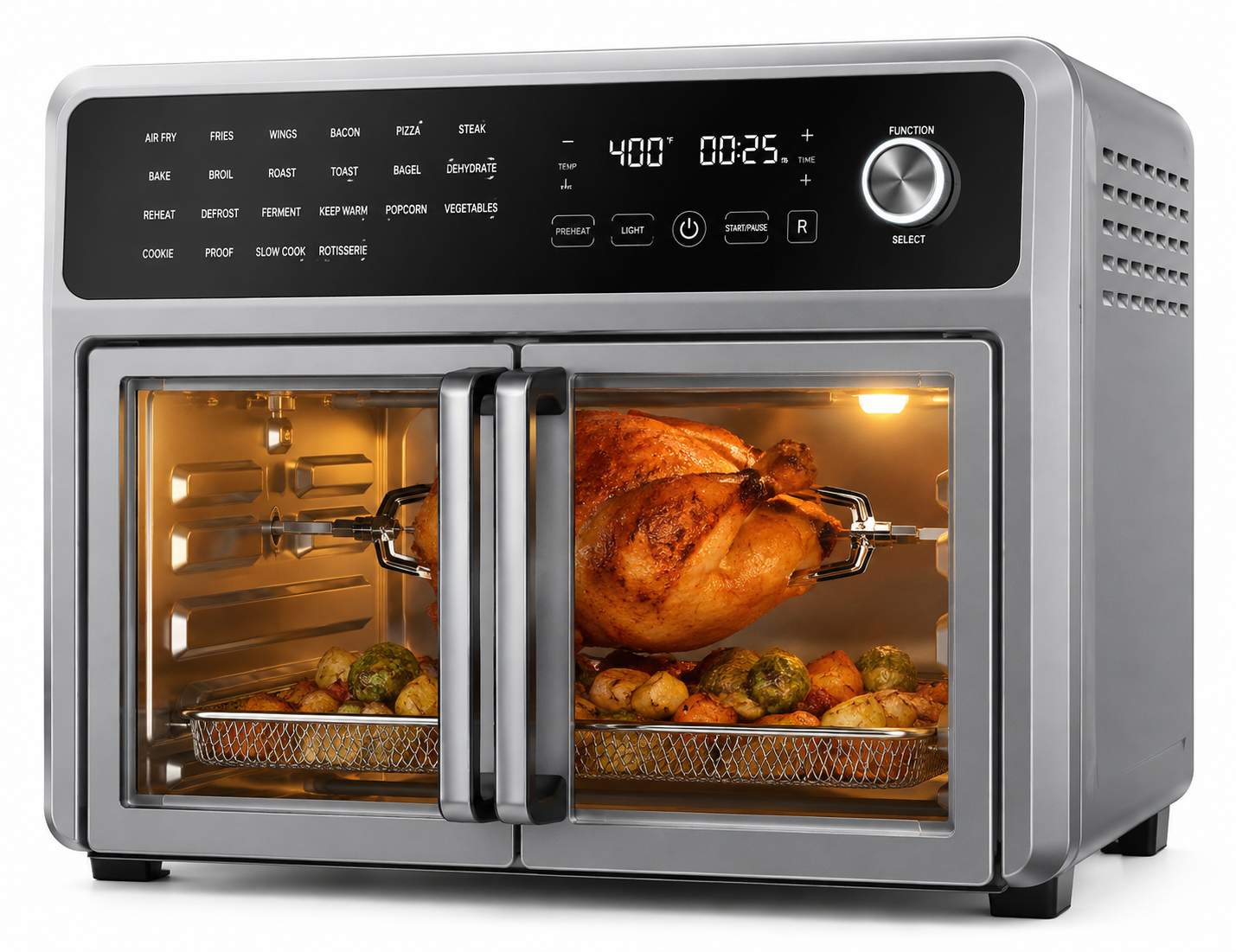
The Emeril Lagasse 26-quart unit represents an ambitious attempt at this consolidation, combining air frying capabilities with toaster oven functionality, rotisserie operation, and substantial cooking capacity. The size alone—26 quarts—positions this in a territory occupied by few competitors. Understanding what this substantial footprint enables, and what practical compromises it might introduce, requires examining both capabilities and realistic kitchen integration scenarios.
This isn’t a device for those managing tight space constraints or seeking subtle kitchen integration. It’s a statement appliance designed for serious cooking enthusiasts or large households where cooking is a central activity. The implications of this positioning influence everything from placement through realistic usage patterns.
Core Features and Technical Specifications
French Door Design and Configuration
The French door construction represents a deliberate design choice influencing both accessibility and functionality. Traditional air fryer designs open from front, top, or sides with varying practical implications. French doors open sideways from the center, providing wide access to the interior cooking chamber without obstruction.
This design matters practically. Wide-opening doors facilitate loading and unloading without requiring foods to navigate narrow openings. Larger items, platters, or multiple components access the interior more easily. The psychological benefit of feeling less constrained during loading shouldn’t be dismissed—it influences how freely people use the appliance.
The dual-door approach also affects heat loss during access. Opening single hinged doors on opposite sides has different thermal implications than single wide openings, though practical differences remain minimal compared to door opening duration impact.
Capacity and Size Dimensions
Twenty-six quarts represents substantial volume—nearly three times typical large air fryers and roughly twice the largest single-basket traditional air fryers. To contextualize, this capacity accommodates a whole rotisserie chicken, a large batch of vegetables, or components for feeding a gathering.
The physical footprint matching this capacity is not minimal. This appliance occupies measurable counter space—comparable to a conventional countertop convection oven. Kitchen layouts capable of accommodating this commitment are not universal. Placement requires dedicated counter real estate or accepting that the appliance becomes a semi-permanent fixture.
Twenty-Four Cooking Functions
The specification of 24 distinct cooking functions suggests comprehensive functionality. This number likely includes variations—different settings for preparing different proteins, vegetables, and baked goods, rather than fundamentally different cooking methods. Understanding what these 24 options actually represent matters more than the number itself.
The functions likely encompass air frying at various temperature and duration presets, rotisserie operation at different speeds, conventional baking, broiling, reheating, dehydrating, and various preparation-specific presets developed or tested by the brand. This comprehensive menu reduces the need for recipe experimentation, particularly for users less comfortable with cooking parameter adjustments.
Dual-Speed Fan Operation
The dual-speed fan capability addresses a genuine air frying challenge—different foods cook optimally at different air circulation speeds. Delicate items benefit from gentler circulation, while hearty foods or items requiring aggressive browning benefit from maximum speed.
This flexibility expands what can be cooked effectively in a single device. Omitting this capability would force compromises—either all foods receive too much circulation or insufficient circulation for optimal results.
Rotisserie Functionality
The integrated rotisserie transforms this from an air fryer oven to something distinctly different. Whole chickens, small turkeys, or entire portions of meat rotate slowly over heating elements, achieving particular browning and texture characteristics impossible through static cooking.
Rotisserie cooking appeals to many for both practical and psychological reasons. The visible cooking process has entertainment value, and rotisserie-prepared foods develop specific flavors and textures. The capability essentially adds a cooking method unavailable in units lacking this feature.
Material and Construction
The stainless steel construction suggested by typical branding for premium kitchen appliances indicates durability expectations. Steel resists corrosion and wear better than cheaper alternatives, justifying the substantial investment required for this capacity and functionality.
Interior construction quality significantly influences long-term performance. Non-stick coatings on interior surfaces affect cleaning ease and durability. Insulation quality influences cooking consistency and energy efficiency.
Understanding Practical Capabilities and Limitations
Rotisserie Operation and Practical Use
The rotisserie capability enables specific culinary outcomes—whole roasted chickens, turkey, or substantial meat portions developing crispy exterior skin while remaining moist inside. This cooking method has genuine advantages for certain dishes, but requires planning and preparation different from standard air frying.
Rotisserie cooking requires foods appropriate for this method and consideration of rotation mechanics. Not all foods work well with spinning rotation. Proper balance and securing mechanisms prevent instability or safety issues.
Air Frying in a Large Format
The substantial volume influences air frying dynamics. Larger chambers mean longer air circulation paths—some foods in the chamber’s back regions don’t experience air velocity equivalent to those near circulation sources. Load arrangement and food positioning matter more in larger chambers than compact fryers.
This consideration doesn’t negate functionality but acknowledges that air frying efficiency varies with chamber size and load configuration. Understanding optimal loading patterns maximizes this appliance’s air frying capabilities.
Capacity Versus Load Consistency
Twenty-six quarts capacity sounds impressive, but optimal loading for consistent results often uses less capacity than theoretically possible. Overcrowding compromises air circulation and results in uneven cooking. Practical maximum loads often represent 60-70% of theoretical maximum capacity.
Realistic expectations about actual usable capacity prevent disappointment when optimal cooking requires leaving substantial empty space.
Baking and Conventional Oven Functionality
While marketed as a multi-function device, the toaster oven aspect functions differently from dedicated baking appliances. Air circulation differs from static baking environments. Results compare reasonably to conventional toaster ovens but differ from full-size oven experiences familiar to most cooks.
This functionality extends versatility without claiming equivalence to dedicated appliances. Understanding actual capabilities prevents unrealistic expectations.
Practical Applications and Use Scenarios
Large-Batch Meal Preparation
The capacity suits situations where substantial quantities need preparation—family gatherings, entertaining groups, or batch cooking for meal preparation across multiple days. One session can produce substantial quantities of prepared components.
Developing Sophisticated Meals
The combination of capabilities enables preparing complete meals within a single appliance—proteins via rotisserie, vegetables via air frying, accompaniments via baking—all coordinated with proper timing. This consolidation appeals to those seeking cooking complexity within space constraints.
Entertaining and Hosting
When hosting gatherings, the rotisserie capability provides an impressive focal point while delivering excellent food. The capacity enables preparing substantial quantities without sequential batching. This appeals to entertaining enthusiasts.
Serious Home Cooking
For those viewing cooking as a central household activity, the comprehensive capabilities and capacity justify the space commitment. Users who cook multiple times weekly benefit from the functionality density.
Supplementing Full Kitchen Cooking
In homes with complete kitchen facilities, this unit supplements conventional cooking by providing air frying, rotisserie, and additional baking capacity. It doesn’t replace existing appliances but extends capabilities.
Alternative Cooking Methods Exploration
The 24 functions and diverse capabilities invite experimentation with cooking methods some home cooks never explore. Dehydrating, precise temperature control, and specialized cooking modes become accessible.
Who This Appliance Is Suitable For
Large Families
Households with multiple family members benefit from capacity enabling meal preparation in single batches. Entertaining guests becomes less complex when capacity accommodates serving multiple people simultaneously.
Serious Entertaining Enthusiasts
Those regularly hosting gatherings appreciate the rotisserie capability and substantial capacity. Impressive roasted whole birds contribute to entertaining success.
Dedicated Home Cooks
Individuals or couples for whom cooking is a central household activity benefit from exploring the diverse capabilities. Serious cooks appreciate comprehensive functionality.
Those with Adequate Space and Electricity
The appliance demands dedicated counter real estate and adequate electrical capacity. Homes with spacious kitchens and modern electrical systems accommodate this more readily than smaller homes or older spaces.
Downsizing or Apartment Living with Adequate Space
Some modern apartments and smaller homes accommodate large appliances if counter real estate is available. Those unwilling to maintain conventional ovens alongside other appliances might consolidate to this comprehensive alternative.
Exploring Culinary Methods
The diverse functionality invites experimentation. Users curious about rotisserie cooking, dehydrating, and specialized preparation methods appreciate having capabilities available.
Important Considerations and Potential Challenges
Counter Space Commitment
The 26-quart capacity requires substantial permanent or semi-permanent counter dedication. Many kitchens lack sufficient counter space for both this appliance and normal food preparation. Storage requirements during non-use need planning.
Electrical Requirements
Substantial power requirements—likely exceeding 2000 watts during intensive operations—demand appropriate electrical infrastructure. Older homes may require electrical work before safely operating this appliance. Verifying available capacity before purchase prevents frustration.
Ventilation and Heat Dispersal
Large appliances produce substantial heat and cooking vapors. Placement requires adequate ventilation space, preventing damage to cabinets, walls, or adjacent surfaces. Kitchen ventilation adequacy influences both performance and safety.
Initial Learning Curve
Twenty-four functions create complexity requiring some learning. Understanding optimal settings for different foods, arrangement patterns for consistent results, and the rotisserie’s specific operational requirements takes time.
Maintenance and Cleaning
Larger interior chambers require thorough cleaning. Interior coatings, rotisserie mechanisms, and numerous surfaces demand regular attention. The time commitment for maintenance exceeds smaller appliances.
Preheat Times and Patience
Larger units require longer preheating than compact alternatives. Realistic expectations about preparation time prevent frustration with perceived slowness.
Space Limitations Despite Large Capacity
While capacity is substantial, practical load limitations exist. Learning what realistically fits without overcrowding becomes important for optimal results.
Frequently Asked Questions
How much counter space does this appliance actually require?
The 26-quart capacity necessitates substantial footprint—typically approaching two to three feet of counter width plus depth. Measuring your specific counter space before purchasing prevents disappointment.
Can this replace a conventional oven?
For some cooking applications, yes. However, it’s not equivalent for all baking needs or cooking scenarios. It represents a supplement or alternative for specific uses rather than a complete replacement for most households.
How long does preheating typically take?
Larger units require longer preheating—typically 10-15 minutes depending on target temperature. This differs from quick preheating of compact alternatives.
Is the rotisserie truly worthwhile, or marketing gimmick?
For those planning to cook rotisserie preparations, it delivers genuine value. Those rarely preparing whole roasted birds might not use this feature frequently enough to justify the space and complexity.
How many amps does this appliance require?
Specific electrical requirements depend on exact specifications, but units of this class typically draw 15-20+ amps. Verifying available capacity with an electrician before purchase prevents issues.
Does the air fryer function actually work with all that capacity?
Yes, but optimal loading patterns become important. Overcrowding compromises air circulation. Understanding load arrangement for different foods ensures consistent results.
Is cleaning actually manageable?
More time-intensive than smaller appliances. Non-stick interior coatings simplify cleaning, but the chamber’s size still demands thoroughness.
Conclusion
The Emeril Lagasse 26-quart French door air fryer toaster oven represents an ambitious consolidation of diverse cooking capabilities into a single substantial appliance. For households where cooking is central and counter space accommodates the footprint, the comprehensive functionality and capacity deliver genuine value.
The combination of air frying, rotisserie operation, conventional baking, and numerous specialized cooking functions enables culinary approaches unavailable in smaller or simpler appliances. The French door design, dual-speed fan, and substantial capacity distinguish this from standard air fryer offerings.
The realistic limitations—space demands, electrical requirements, longer preheat times, and learning curve—shouldn’t be dismissed. This appliance serves specific households and cooking scenarios well, while being fundamentally inappropriate for others.
The decision to invest in this substantial appliance should flow from genuine household cooking patterns and available space, rather than aspirational cooking intentions or impressive specifications. For those situations where it genuinely matches actual needs, it delivers comprehensive cooking capability that justifies the commitment.